
 BACK TO MARKET SIGNALS
Making Sense of Illustrative Mathematics: A District Leader’s Guide
Illustrative Mathematics is used by districts nationwide, serving more than 5.3 million students, according to CEMD’s 2024–25 research. Because IM is available through multiple product offerings, understanding the differences among them is essential for making an informed district decision. This resource explains how IM operates within the K–12 curriculum market.


The Center for Education Market Dynamics • December 22, 2025
Across the country, many districts are gathering their selection committees, reviewing processes, and preparing for a new math curriculum selection. After they’ve defined their instructional vision and have set the key criteria to prioritize in their search, research begins.
As they explore the many available options for high-quality instructional materials (HQIM), they will inevitably come across Illustrative Mathematics® (IM)’s curriculum as an option to investigate. But digging in to learn more about the product offering can be surprisingly complex—there are multiple different providers that offer the Illustrative Mathematics curriculum, or claim to be authored by the Illustrative Mathematics authorship team. For example, in California, where a statewide curriculum adoption is underway, there are six distinct K-5 products alone that cite a connection to IM on the state-approved instructional materials list.
Unlike most commercially available products that are exclusive to the publisher that created them, IM’s curriculum is first and foremost, an Open Educational Resource (OER). Open Educational Resources (OER) are instructional materials that are freely available for downloading, editing, and sharing in order to better support all students. Depending on the specific license, some OER permit only free use and download, while others also allow adaptation and modification of the content. By removing cost barriers, OERs were developed to promote equity and ensure that every learner can benefit from high-quality instructional materials.
Then and Now
Illustrative Mathematics first came about in the post-Common Core era when new OER materials were beginning to be developed and come to market. In order to maximize their reach without building a large sales team, the organization took a unique approach by licensing their IM® K–12 Math product to other curriculum organizations. By developing partnerships with organizations who had greater distribution and scale, they were able to get the IM curriculum in front of districts nationwide. This created a network of IM Certified® partners. Their approach was successful; research by CEMD has identified the Illustrative Math curriculum distributed by IM Certified partners in over 250 districts nationally during the 2024–25 school year.¹
Like many other curricula programs, over time updates are needed to align with user feedback, meet emerging needs, or add features that reflect the best practice and research of the day. The most recently published version from Illustrative Mathematics is IM® v.360. According to the organization “IM® v.360, released in 2024, is IM’s most comprehensive curriculum upgrade to date. It builds on the foundation of previous IM® Math versions, maintaining core tenets of IM while incorporating new additions and enhancements.”² To date, all versions of the program, including those from IM Certified providers, have been rated high–quality by EdReports, passing gateways of Focus and Coherence, Rigor and Mathematical Practices, and Teacher and Student Supports. Beyond an “EdReports green rating,” these products have been reviewed by multiple states and are included on their recommended materials lists.
Navigating Your Options
For school districts looking for new instructional materials, accessing the free OER IM Math v.360 is a readily available option at AccessIM.org.
Districts often find that they’d like some of the benefits that come along with formally procured solutions—benefits such as additional digital or print formats, designed digital assessments, or aligned professional learning resources. In these situations, understanding the range of provider options is critical to making the adoption decisions that meet the unique needs of the school district community.
Three IM Certified partners distribute comprehensive core curriculum materials for district purchase.
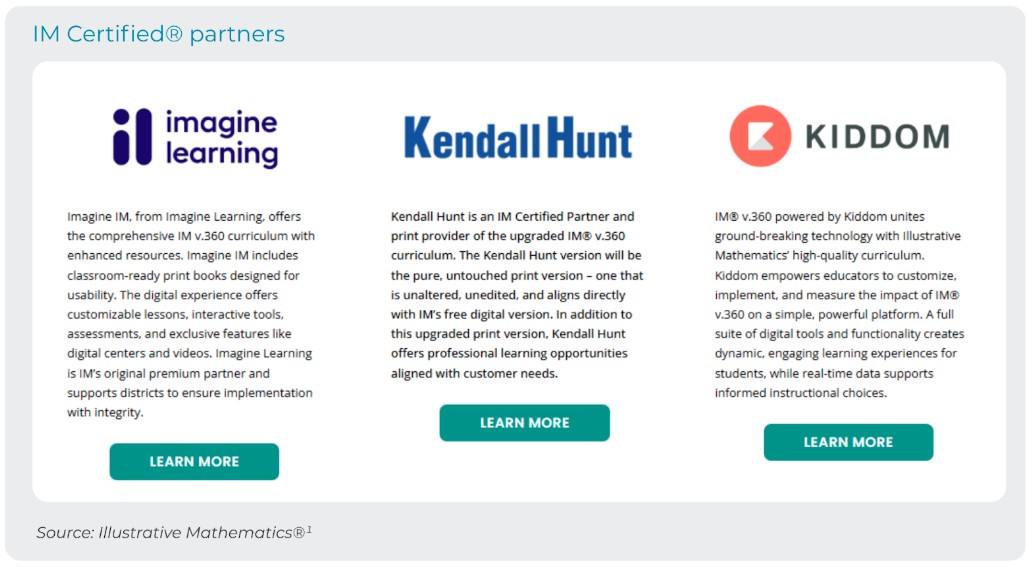
These three IM Certified partners have built their own products, using IM Math v.360, and are held to IM’s standards with any program additions. According to Illustrative Mathematics, “The IM Certified® designation ensures that schools and districts are accessing curricular materials that are always up-to-date, high-quality, and aligned to IM’s vision and guarantee any curriculum enhancements are thoroughly vetted by the IM authors.”³
Since these three organizations bring IM Math v.360 to life on their own platforms, in their own unique way, they each hold benefits and tradeoffs when it comes to classroom implementation. When choosing between these products, district leaders can feel confident they are receiving vetted IM content, while focusing their review and adoption decisions on the usability, accessibility, and added features present between these products.
Districts also have the opportunity to adopt materials built on a foundation of IM K-12.
Because IM K–12 Math is an open educational resource (OER) and available for free under a Creative Commons (CC BY) license, this means that other curriculum providers can also use Illustrative Mathematics’ content as the foundation for their product. These products often share that their materials are “based on,” “authored by,” or “inspired by” Illustrative Mathematics. District leaders and adoption committees might hear these phrases within product presentations or see the credit given in marketing materials. Products that cite a foundation built on Illustrative Mathematics’ curriculum include:
- Amplify Desmos Math
- Open Up Resources K–5 Math
- Math Nation from Accelerate Learning
Each of these products have made their own reach into classrooms and districts across the country and have “Meets Expectations” EdReports reviews of recent product iterations. When considering a product specifically for its connection to Illustrative Mathematics, it is important to know these products have different content development processes as certified partners when it comes to Illustrative Mathematics content. This means they can adapt and build upon content as needed throughout their own curriculum design process. Intentional review of products is helpful in identifying any changes that have been to the foundational IM K–12 Math curriculum.
Illustrative Mathematics content is also found in supplemental math curricular materials, both from certified partners and those providers utilizing the OER content. Current IM Certified® partners of supplemental materials include BetterLesson, Hand2Mind, Cognia, and Teaching Lab. The number of supplemental materials pulling from IM continues to grow, with new generative AI tools for teacher lesson planning and AI-enhanced student tutoring products coming to market rapidly.
Digging In
Luckily for districts, there are ways to learn more and explore tradeoffs across all these products—-both certified and derivative.
EdReports continues to release new reviews of these products, and others, that allow leaders to explore differences across products. New reviews are continually released; visit edreports.org to view the most recently reviewed products and learn what is coming soon.
Another opportunity is to “walk a lesson” by selecting a common lesson across two or more products and deeply reviewing the way the content is similar or altered.
- Is the lesson construction common across products?
- How has teacher support been enhanced or adapted?
- What is the role of digital supports across the lesson?
- What other components are present or added that support the lesson? Do additions enhance or detract from lesson effectiveness?
As districts consider adopting new math curricula, they have more high-quality options today than ever before. Because Illustrative Mathematics offers its curriculum under open licenses and IM Certified partnerships, district leaders will encounter a variety of IM-related products in the market. Understanding which versions are IM Certified and which are independent adaptations helps ensure districts understand the dynamics of these materials and through effective adoption processes, select materials that best align with their instructional vision and local priorities.
CEMD’s mission is to provide transparent market intelligence to support informed district decision-making. This analysis examines the market dynamics surrounding Illustrative Mathematics content in response to field feedback. The inclusion of any materials or organizations in this report does not constitute an endorsement by CEMD of any materials or organization.
¹ Sample includes core math selection data from 2,725 districts for the 2024–25 school year. To learn more about district selections across the country, visit CEMD’s Market Explorer.
² Math Curriculum. (n.d.). Illustrative Mathematics K–12 Math. Retrieved November 20, 2025,
from https://illustrativemathematics.org/math-curriculum/
³ IM Certified Professional Learning—Frequently Asked Questions. (n.d.). Illustrative Mathematics K–12 Math. Retrieved November 20, 2025, from https://illustrativemathematics.org/professional-learning/faq/

