
 BACK TO MARKET SIGNALS
Relentless Learning in Tustin USD
CEMD met with Tustin Unified and OCDE leaders to see how they’re using California’s new math adoption to rebuild a shared vision for high-quality instruction—before choosing new materials.


The Center for Education Market Dynamics • December 04, 2025
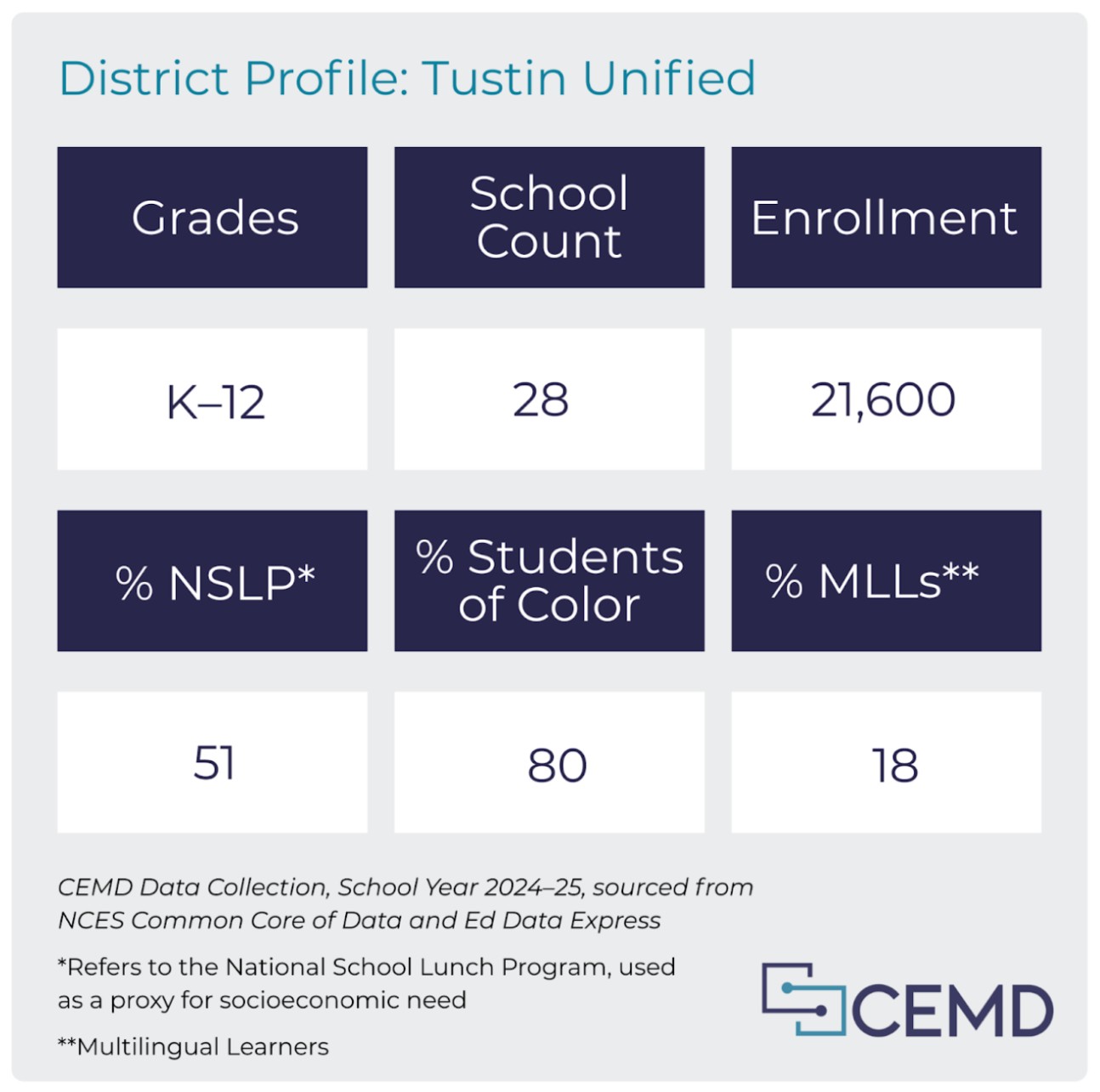
CEMD’s recent California math market reports show that up to 650 districts may select new materials in the next two years. For many school systems, this represents a significant opportunity to reflect and revise their math strategy as 33% of California districts still have materials that were from the last state adoption in 2015. Tustin Unified SD is one of these districts. We recently met leaders from Tustin and the Orange County Department of Education to learn more about their goals for transforming math education and how they are leveraging the current state adoption process to advance change.
When leaders in the Tustin Unified School District began planning for California’s new math adoption, they started with reflection—while they had led many adoptions over the past several years, this process needed to be different.
“Our last math adoption was in 2013,” shared Karen Knudson, Tustin’s Coordinator of Elementary Education. “After ten years, you lose the center. The materials age, teachers shift, priorities evolve, and over time the common vision of what great math instruction looks like starts to fade.”
That realization became a catalyst for rethinking how to structure learning around the upcoming materials adoption. Tustin’s leaders saw it as a chance to rebuild coherence and to restore that center.
“We made a choice to center our work on learning for teachers, for leaders, for us as a system,” said Maggie Villegas, Tustin’s Assistant Superintendent of Curriculum and Instruction. “That meant our adoption process couldn’t be about picking a product. It had to be about reestablishing a shared understanding of what high-quality math teaching looks like.”
The district calls this mindset relentless learning, and it has guided Tustin’s transformation. Supported by the Teaching Learning and Instructional Leadership Center at the Orange County Department of Education (OCDE), the district is redefining what quality looks like for a new era of math learning.
Reclaiming the Vision
In 2024, Tustin launched what they called their “learning year”. Before any formal selection process began, teachers, coaches, and principals spent months studying lessons, working problems, and analyzing student thinking. The goal wasn’t to compare programs, but to rebuild the district’s instructional compass.
“We knew we couldn’t just adopt our way to improvement,” Karen said. “Before we even looked at materials, we had to deepen our collective understanding of excellent instruction and make sure every adult in the system could describe it and see it.”
OCDE’s Jody Guarino said that intentional pause was key.
“After a decade with the same materials, systems can drift. Tustin used the adoption moment to refocus the whole organization around what it means to learn together.”
Building a System that Learns
To turn their vision into practice, Tustin began with establishing an elementary school lab site. There, teachers, coaches, and administrators experimented with new structures for collaboration: weekly grade-level meetings anchored in upcoming units, in-class coaching tied to shared problems of practice, and regular reflection sessions about student reasoning.
The lab site also served as a demonstration site in which all principals and instructional coaches across the district could observe new practices in action and learn together. These observations and lessons are then debriefed and reinforced through monthly leadership sessions for principals and biweekly coaching sessions.
“We wanted to see what it really takes to create a culture of professional learning grounded in math instruction,” said Maggie. “The lab site gave us a place to test, to iterate, and to model what it looks like when everyone—from principal to paraeducator—is positioned as a learner.”
The lab became a proving ground for the structures that now guide Tustin’s system-wide learning design. In year two, those practices have begun to spread. Tustin has opened more lab sites as they move from the learning year into the pilot year, enabling more opportunities to study how to facilitate rich discourse, analyze student thinking, and support teacher collaboration in ways that build collective efficacy.
“Everyone is a learner here,” Maggie said. “That’s what relentless learning means; no one is exempt. Our coaches are learning alongside teachers, and our administrators are learning what it means to lead this kind of instruction.”
While not all schools have formally incorporated new problem-based instructional materials into their formal math learning structures, the culture is taking hold districtwide. Teachers at other sites are beginning to engage in similar cycles of collaboration, and principals are using the lab site as a model for what coherent professional learning can look like.
“As Karen described: “We’re learning how to scale learning. The goal is that, over time, every site becomes its own lab for instructional improvement.”
Entering Adoption With a Stronger Lens
Now, as Tustin prepares to select its next math program, the process feels different than those that preceded it. One example of the difference is how teachers approach materials with a clear sense of instructional purpose.
“When our teachers look at curriculum now, they’re not asking, ‘Do I like this lesson?’” Maggie said. “They’re asking, ‘How will this help students reason mathematically and make sense of problems?’ That’s a huge shift, and it came from learning together before adoption.”
Tustin teachers and coaches have begun their formal piloting and selection process, and the team is confident that this process will lead to materials that will serve as a strong instructional center for many years to come.
“Tustin has shown what it looks like to build the conditions before you choose the materials,” said Jody. “That’s the difference between short-term checking-the-box for materials adoption and long-term coherence.”
Learning That Lasts
For CEMD’s Executive Director, Lora Kaiser, Tustin’s story represents the kind of systemic capacity building that districts in the state need. “When we talk about relentless learning,” she said, “we’re talking about districts like Tustin that are using every opportunity, such as a new curriculum adoption, as a lever for adult learning.”
A decade after its last adoption, Tustin is not just getting ready for new materials. It’s rebuilding the professional learning culture that will ensure those materials come to life.
What Other Districts Can Learn from Tustin
The Tustin and OCDE teams shared several lessons that could help other districts approach their own adoptions as opportunities for learning:
- Start with the “why.”
Before reviewing materials, articulate the vision for teaching and learning that the materials should advance. “If you don’t have a shared definition of excellent instruction,” Karen said, “it’s hard to know what you’re looking for.” - Invest in leaders’ learning early.
Principals and instructional coaches are the levers for sustaining professional learning. Giving them time and structures to study math instruction together helps them lead with clarity and coherence. - Create a lab or demonstration site.
A single site where structures are tested and refined helps the system learn in real time. “It’s where you can try things, get feedback, and model what’s possible,” said Maggie. - Treat adoption as professional learning, not procurement.
Tustin’s process emphasizes that curriculum selection is an act of instructional leadership. Jody noted, “Every conversation about materials is a conversation about learning.” - Scale culture, not just structures.
Not every teacher has to start at the same time. Build belief and momentum through small, visible successes that show what a culture of learning looks like in practice. - Stay relentlessly curious.
Even with new materials, the learning continues. As Maggie put it: “We’re not just preparing to adopt. We’re preparing to keep learning after we do.”
By embracing adoption as a systems-learning opportunity, Tustin is laying the groundwork for coherent instruction that will outlast any single set of materials. Their story illustrates how districts can use this moment to invest in people, practice, and long-term instructional capacity. To read more of CEMD’s work in California, visit our CA Hub.

