
 BACK TO MARKET SIGNALS
Building District Readiness for Curriculum Adoption: Insights From Fresno County
Fresno County’s math curriculum adoption work shows how county offices can build district readiness by coordinating expertise, sequencing learning, and centralizing information before publisher engagement. The county focused on creating the conditions for informed, locally grounded decisions.


The Center for Education Market Dynamics • February 12, 2026
CEMD has documented how state adoption cycles shape district curriculum adoption practices. These cycles also affect how regional intermediaries – the “middle layers” between state policy and district decisions – impact how districts approach quality curriculum adoption and implementation. In California, County Offices of Education are the primary mechanism for bridging state-level policy and guidance with district-level decision making. We had the opportunity to observe and learn alongside Fresno County as it built new systems and structures to support districts of all sizes to navigate an evolving materials market.
Between Policy and Purchase: How Fresno County Builds District Readiness for Curriculum Adoption
When we talk about how curriculum decisions get made, we usually focus on two sets of actors. Districts are the decision makers and purchasers. States set standards, guidance, incentives, and, where they exist, adoption lists that define which materials meet state expectations. This framing makes sense. Districts control the dollars, and states establish the policy environment in which those decisions occur.
What this framing often misses is the role of the middle.
Across the country, regional intermediaries play a critical role in shaping how districts experience the curriculum market. In Wisconsin, these are CESAs; in Ohio, ESCs; in New York, BOCES; in California, they are County Offices of Education.
Regional intermediaries such as California’s County Offices of Education do not select materials or control budgets. But they shape the conditions under which districts make decisions: what information is centralized, how learning is sequenced, and how prepared district teams are to engage the market.
As Meagan Thompson, Math Coordinator at the Fresno County Office of Education, put it, “We don’t choose for districts. Our role is to create the conditions that make informed decisions possible.”
Fresno County in Context
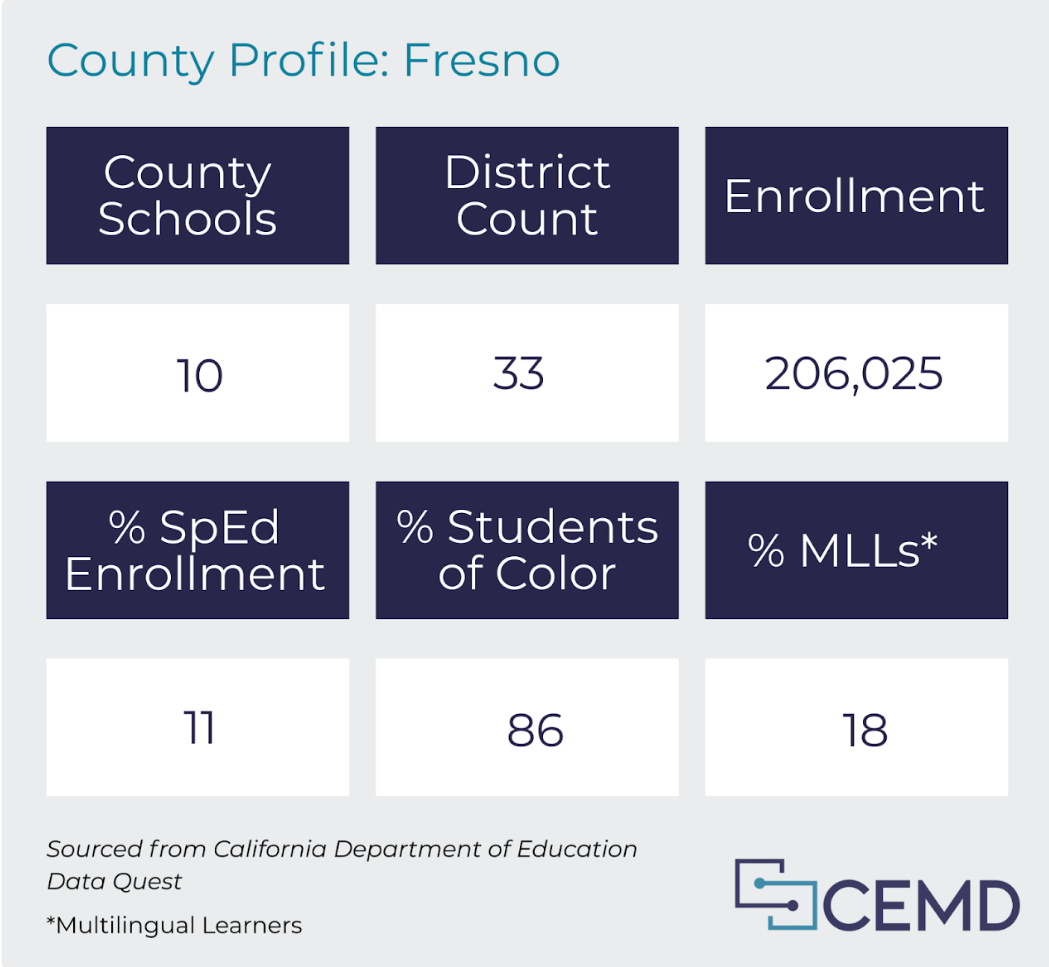
California has 58 County Offices of Education. Fresno County is one of the largest and most diverse, supporting districts that range from very small rural systems to some of the largest in the state. The county serves communities with high proportions of multilingual learners and students from historically underserved backgrounds, making instructional coherence and quality especially important.
Math adoption in California has also been shaped by time. It had been more than a decade since many districts last selected new math materials. During that gap, districts adapted by creating and curating their own resources while waiting for materials aligned to the updated framework and state review process.
As Meagan observed, “A lot of teachers had already created so much on their own that districts felt they could hold out and wait until better materials came along.” When the new state list was released, that waiting turned quickly into urgency.
For Fresno County, this moment also coincided with an internal shift. This was the first time the county had supported a math adoption with a dedicated math coordinator role. Expectations from districts were high, and it was clear that repeating past approaches would not be enough.
Districts were not just looking for the county to organize a curriculum fair. They were looking for guidance on how to approach the adoption process, how to interpret the new framework, and how to navigate a crowded and unfamiliar market.
“I knew there was a need,” Meagan explained. “The framework was out, the state list was coming, and I had never led this before. I needed to learn, and then bring that learning back to the county.”
Rather than waiting for a state-developed toolkit, Fresno County began assembling an approach grounded in district needs. The goal was not to tell districts what to choose, but to create shared learning experiences that would help them choose well.
Coordinating Expertise Around District Priorities
One of Fresno County’s first moves was to coordinate external expertise in response to district interest. An early learning opportunity with CalCurriculum focused on understanding the adoption process drew far more participants than expected.
“I sent out an email and created a registration right away,” Meagan recalled. “We had about a hundred people sign up in a week and a half. That doesn’t usually happen here. It told us how much districts needed this.”
Building on that momentum, the county organized two years of district cohorts focused on math adoption. These cohorts, facilitated by UnboundEd, were designed with clear milestones, helping districts move from learning about the framework to clarifying non-negotiables, developing local evaluation tools, and preparing for engagement with publishers. Meagan highlighted that finalizing a local evaluation tool was a critical step in the districts’ journeys: “Creating their own tool makes the process theirs. It reflects their priorities, their data, and their community.”
In its role as convener, the county could ensure that even the smallest district had the opportunity to learn from national experts in curriculum and adoption, notably UnboundEd and the English Learner Success Forum (ESLF). The county worked with both organizations to provide districts with a seamless experience that emphasized building a lens for quality multilingual supports within the adoption process. “That lens needed to be built into how districts were evaluating materials,” Meagan said, “not treated as a separate conversation.”
Using the Curriculum Fair as a Culminating Event, Not a Starting Point
Curriculum fairs are a familiar feature of adoption cycles, and Fresno County hosted one as well. The fair, however, was intentionally positioned as a culmination of learning rather than a starting point. All publishers on the state-approved list were invited, ensuring transparency and equitable access.
Leading up to the fair, districts in the cohorts had already clarified priorities and narrowed their focus. The county collected districts’ non-negotiables and questions, sent these to publishers to complete in advance, and compiled answers for district teams to review. Districts throughout the county had similar questions, for example, robust multilingual learner supports, compatibility with existing learning management systems, and availability of print and online resources.
“Otherwise, everyone was going to start emailing publishers and asking the same questions,” Meagan explained. “I thought, let me just do it once for everybody.”
On the day of the fair, district teams arrived prepared, having already determined their non-negotiables, learned as teams, and winnowed to a few options that would get a closer look. “I really wanted districts to come in ready to winnow their choices,” Meagan said. “Not just walk around and take it all in.”
County staff supported logistics, facilitated connections, and created space for teams to reflect together. For many districts, particularly smaller ones, this was their first opportunity to engage deeply with multiple publishers in a structured way.
Lessons for Other Counties and Regional Intermediaries
Fresno County’s experience reinforces a central finding from CEMD’s research: curriculum markets are shaped not only by policy and product quality, but by readiness and information flow. When districts enter adoption cycles without shared criteria or structured learning, decisions can default to familiarity, marketing visibility, or speed.
Regional intermediaries, including those outside of California, can materially alter that dynamic. By coordinating expertise, centralizing information, and sequencing learning before publisher engagement, counties reduce fragmentation and can help districts – particularly smaller systems – approach the market more deliberately.
In a field that often centers districts and states, Fresno County’s work underscores the importance of the middle in shaping how districts select and how well positioned they are to implement selections over time. As Meagan reflected, “There’s only so much a county can do, but we can design the conditions that make good decisions more likely.”
To learn more about districts utilizing county office support for their adoption processes, read Curriculum Adoption as a Hinge-Point for Systemwide Transformation.
To learn more about Fresno County’s commitment to supporting multilingual learners, see Meagan’s op-ed in EdSource: How district leaders can get math education right for California’s English learners.

